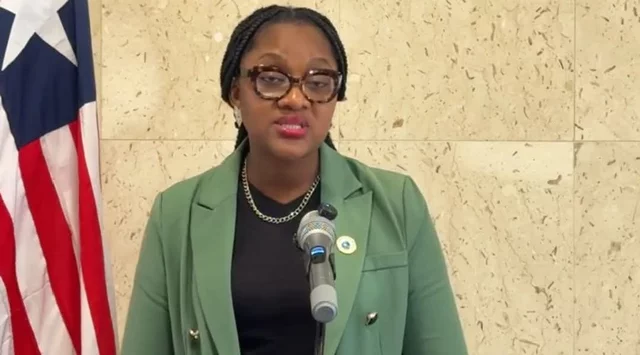
Liberia’s political and security landscape is currently embroiled in a brewing controversy following public remarks by Atty. Kula Fofana, Press Secretary to President Joseph N. Boakai. Her recent defense of a group calling itself the National Fula Security (NFS) has ignited a fierce debate over the boundaries between personal opinion and official government posture.
While Atty. Fofana has adamantly maintained that her comments were made in a personal capacity; critics argue that her role as the President’s chief spokesperson makes it impossible to separate her private views from the weight of the Executive Mansion. The remarks have fueled public suspicion that the administration may be tacitly endorsing a group that remains unrecognized by—and unknown to—state security authorities.
The perception of an official “nod” to the NFS is sharply at odds with the stance of Liberia’s formal security apparatus. Both the Ministry of Justice and the Liberia National Police (LNP) have publicly distanced themselves from the group, stating they have no formal relationship with, or legal knowledge of, the “National Fula Security.” This contradiction has intensified concerns regarding policy coherence and the government’s handling of sensitive security matters.
In a detailed statement released amid mounting pressure, Atty. Fofana—who identifies as a prominent member of Liberia’s Muslim community—rejected allegations that she supports any paramilitary formation. She underscored her opposition to “any military or paramilitary organization whose purpose is to cause violence, intimidation, or destabilization,” emphasizing that her personal values are rooted in peace, national unity, and the rule of law.
Despite these assurances, many Liberians remain skeptical. Analysts argue that when a senior presidential aide legitimizes a controversial group, the message carries institutional weight regardless of the intended “private” context. As one civil society actor noted, “When you speak from the office of the presidency, there is no purely private lane.”
The controversy was initially sparked by viral video footage showing men in uniforms identifying themselves as members of the National Fula Security. The imagery of coordinated formations and uniforms immediately raised red flags in a nation still healing from the trauma of civil conflict and the presence of irregular armed groups.
In her defense, Atty. Fofana argued that the NFS has existed quietly for years within the Muslim community. She described the group’s role as primarily administrative, providing crowd control during major Islamic events such as Ramadan prayers, Eid celebrations, and visits by international clerics. She specifically cited their work during visits by scholars like Mufti Menk, claiming the group coordinated informally with the LNP to maintain order.
However, security experts and transparency advocates counter that anecdotal success in crowd control does not substitute for legal recognition. Liberia’s security framework does not permit parallel or informal security structures to operate without statutory oversight. While comparisons have been made to volunteer ushers at Christian gatherings, observers point out a critical distinction: church volunteers do not typically brand themselves with names that imply “national” or “ethnic” security authority. The title “National Fula Security” is seen by many as carrying coercive overtones that amplify ethnic mistrust.
The unfolding saga has prompted renewed calls for the Boakai administration to speak with a single, unified voice. Transparency advocates are demanding that the Ministry of Justice clearly define the “red lines” for community volunteerism and determine whether the NFS is operating within the law.
More pointedly, the Executive Mansion faces pressure to clarify whether Atty. Fofana’s remarks reflect a shift in administration policy or a lapse in communication protocol. In the absence of such clarity, speculation continues to fill the vacuum, potentially undermining public confidence in the state’s commitment to professional security sector governance. As Liberia navigates the heightened public gatherings of the religious calendar, the question remains: Can the state afford ambiguity regarding who is authorized to provide security?