Women and children displaced from Saye Town are sleeping on bare porches and in the open air, their mattresses spread under the sky, after a January 31 demolition left hundreds homeless. The demolition followed a court eviction order in favor of a private landowner, bringing bulldozers and front-end loaders into a community many residents say they have occupied since the 1970s and 1980s.
Today, rubble replaces homes. Zinc sheets, broken furniture, and salvaged belongings lie scattered across what was once a tight-knit neighborhood.
“Mosquitoes Are Eating Us Up”
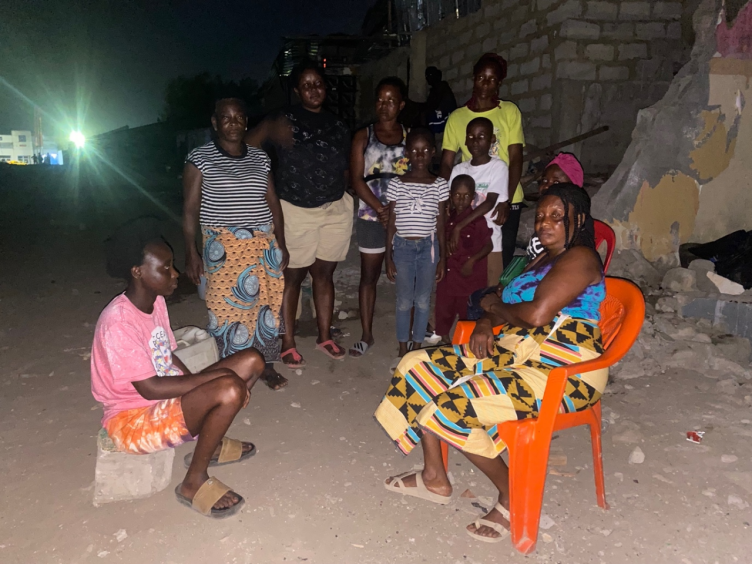
Among the displaced is Ma Marthaline Worlah, who says she has lived in Saye Town for decades.
“I built on this land and lived here for so many years. They broke my house down,” she said in tears. “I have sugar and pressure. When the demolition happened, I went off. When I regained consciousness, I was told not to go back inside. I took nothing.”
Now, she and her sick husband sleep outdoors.
“Mosquitoes are eating us up. The cold is too much. This is not life. We have nowhere to go.”
Worlah said the destroyed home was their only source of income. They rented out rooms to tenants, using the proceeds to support her 16-year-old granddaughter’s education. Now in 11th grade, the child has dropped out due to unpaid school fees.
“We lost everything,” she said. “Life is too bad for us.”
Elderly, Sick, and Stranded
Margaret S. Jallah, who spent 16 years in the community, described the demolition as sudden and devastating.
“The sheriff came and gave us paper to get out. We were confused and took nothing,” she said. “We sleep outside here; no food to eat. I cry many days.”
Jallah, who says she suffers from high blood pressure and cholesterol, fears for her health.
“I am an elderly woman. I don’t have anywhere to go. Rats and mosquitoes are crawling over us at night. Let a destiny helper come and take me from this suffering.”
She said she had been paying US$50 monthly rent and had settled her dues before the demolition.
Disputed Ownership
The demolition was carried out following a court ruling in favor of businessman Eric F. Nagbe, whom residents accuse of illegally acquiring the land—allegations he has denied. Nagbe maintains that he legally purchased the property in 2017 from family factions claiming ownership.
Residents, however, argue that many of them bought or inherited their properties decades ago and question the legitimacy of deeds they say only surfaced in 2011.
While the legal battle continues, the humanitarian consequences are already severe.
Children Out of School
For many mothers, the greatest fear is not just homelessness, but the future of their children.
Justina Karnuah, a mother of three aged 10, eight, and four, says both her home and her children’s school were demolished. “My children are not in school. Nowhere to sleep. Their father abandoned us. No one to help,” she said.
Willeta Robinson, a teacher who inherited her family home—purchased by her grandmother in 1980—said she now faces starting over.
“My children were in 9th and 8th grades. The demolition put them out of school. In the day, we manage. But when night comes, we are worried. Nowhere to sleep.”
Decontee Wolar, who sold water and dry goods to survive, said she lost her business and home in one day.
“I paid my rent in November—US$30 a month. We were not told ahead of time. It happened abruptly,” she said. She has temporarily sent her children to stay with a friend on Old Road but fears they may soon be asked to leave.
“If I can get any help, I can add it and find a place to move.”
Unfulfilled Promises?
In the immediate aftermath, District #8 Representative Prince Toles announced that more than LRD 3.5 million had been secured to provide relief while a verification process was conducted.
“We are deeply saddened by what has happened and will continue to seek additional support for our citizens,” he said at the time.
However, several victims interviewed say they have yet to receive any assistance.
“If we had received help, we wouldn’t be here like this,” said Eyea Kabah, a mother of two. “They come and make promises and go back to their business. We are still sleeping outside.”
Kabah said she remains in the area so her children can attend a nearby school, as she lacks transportation to relocate.
“For me, I want the government to help me pay my rent. We just paid in December. I don’t have money now. If anyone can help me, I will be happy to get out of this cold.”
Residents are calling on Representative Toles, as well as Montserrado County Senators Saah Joseph and Abraham Darius Dillon, to intervene.
A Crisis Beyond the Courtroom
The demolition was executed in a single day—but its consequences may linger far longer.
Hundreds were displaced as heavy-duty equipment tore down homes along 4th and 5th Streets. While the legality of the eviction remains a matter of court record, its human toll is unfolding nightly under the open sky.
As darkness falls in Sinkor, the glow from nearby office buildings contrasts sharply with families huddled beneath mosquito nets and torn blankets.
For the women and children of Saye Town, the legal dispute over land ownership is secondary to a more immediate concern: